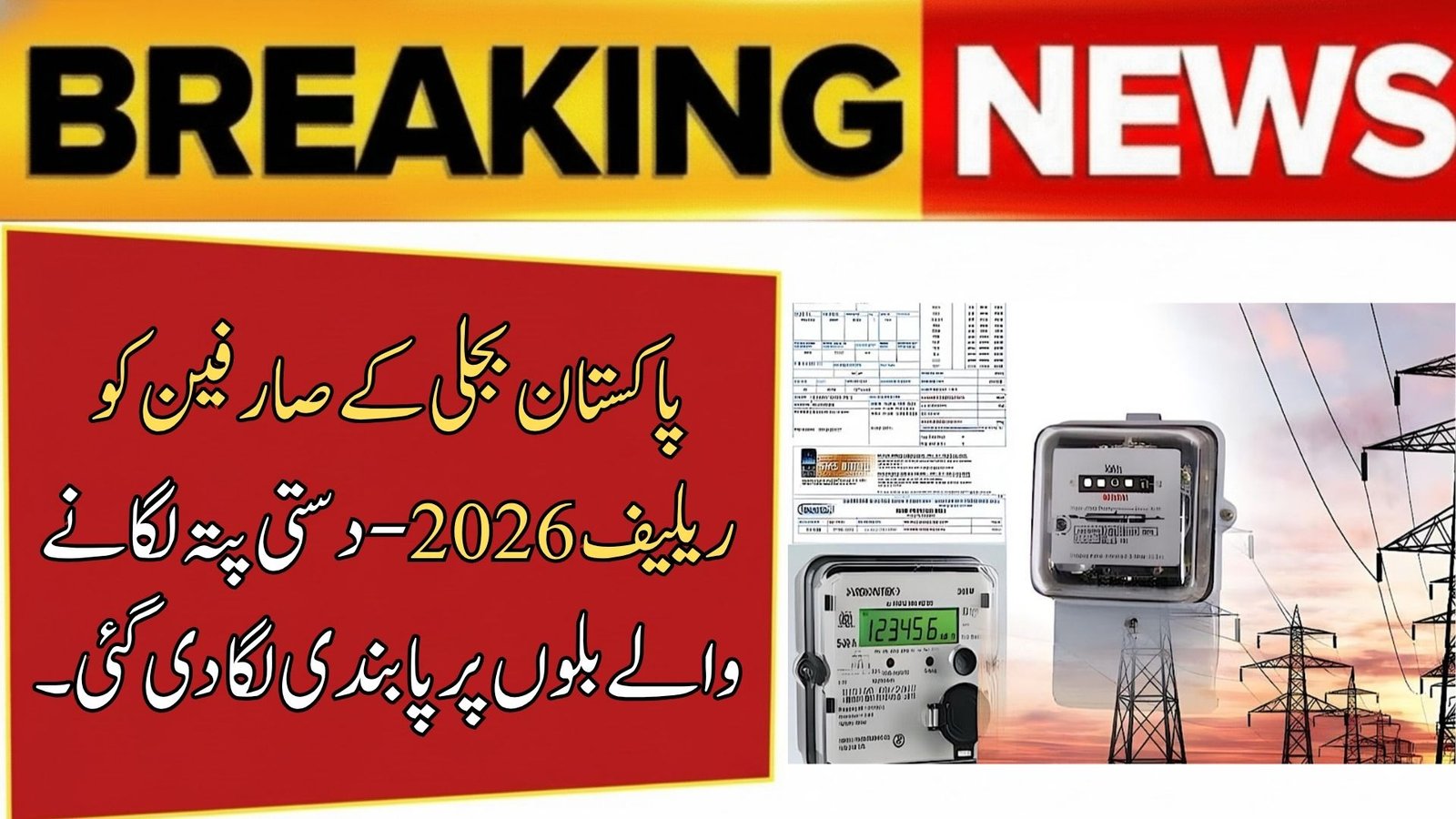
Pakistan Electricity Consumers Relief 2026 – Manual Detection Bills Banned
Pakistan Electricity Consumers Relief 2026
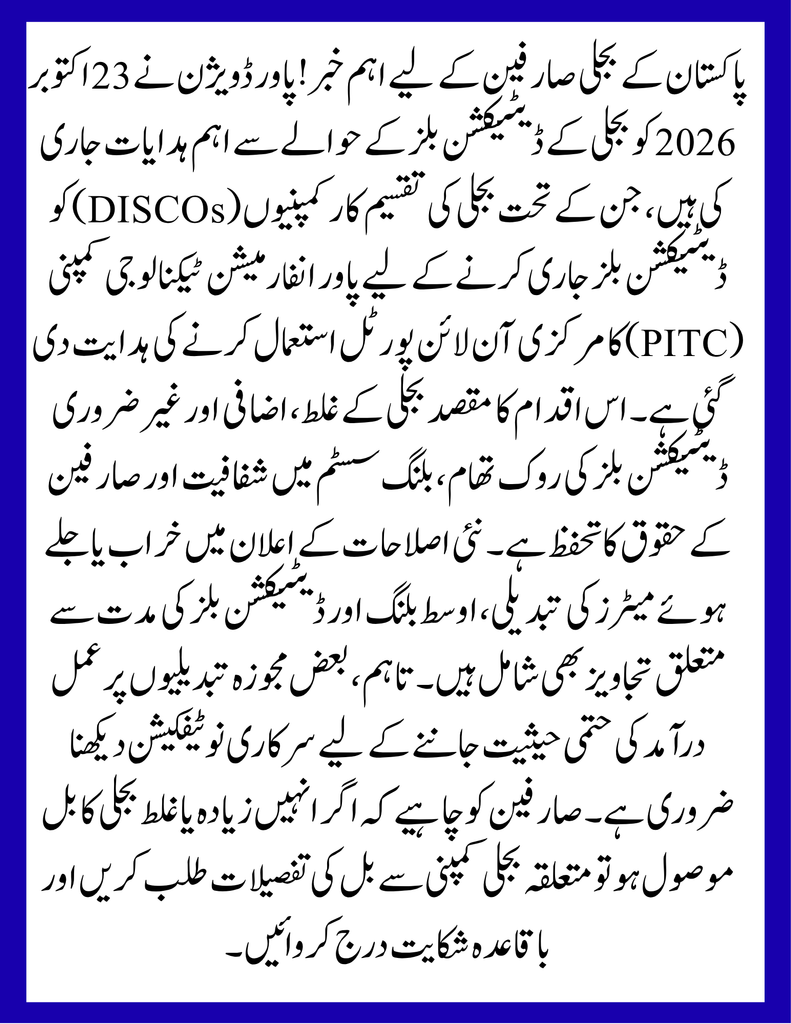
Pakistan Electricity Consumers Relief 2026 has become an important topic for households and businesses following the Power Division’s announcement on October 23, 2026, regarding manual electricity detection bills. The government has directed electricity distribution companies (DISCOs) to process detection bills through a centralized online portal developed by the Power Information Technology Company (PITC). The decision aims to improve transparency, reduce incorrect electricity bills, and protect consumers from excessive and unjustified charges.
Under the announced directions, manual detection billing by field staff and Sub-Divisional Officers (SDOs) has been prohibited, and officials who violate the instructions may face disciplinary action. The reform framework also addresses defective electricity meters, burnt meters, average billing, and the time limits proposed for certain detection bills. However, consumers should distinguish between announced directions and proposed amendments that still require formal implementation.
More Read: LPG Price in Pakistan Today 2026 – Latest LPG Cylinder Rates & Per KG Price
Pakistan Electricity News 2026: Latest Update on Detection Bills
The latest electricity billing update focuses on making the detection billing system more transparent and reducing the risk of arbitrary charges. Detection bills are generally associated with the recovery of electricity charges for a previous period when an issue such as suspected unauthorized consumption, meter tampering, or inaccurate meter recording is identified.
In the past, electricity consumers could face disputes over estimated consumption, the period covered by a detection bill, and the calculation used by the distribution company. A large additional bill could create financial difficulties, especially for families already paying regular monthly electricity charges.
The Power Division’s October 2026 announcement seeks to improve this process through centralized digital billing and stricter monitoring. An earlier announcement on September 4, 2026, also highlighted digitization, automation, and monthly reviews to identify unusual billing patterns.
These measures form part of wider electricity billing reforms in Pakistan. Their purpose is to improve accountability while allowing electricity companies to investigate genuine cases of electricity theft under the applicable rules.
Power Division Bans Manual Detection Bills in Pakistan
The Power Division has directed electricity distribution companies to issue detection bills exclusively through the centralized online portal developed by PITC. Under the announced directions, field staff and SDOs cannot issue manual detection bills through discretionary procedures.
This measure is intended to reduce unnecessary human intervention and ensure that detection bills follow a documented process. The announcement also warns that officials who violate the instructions may face disciplinary proceedings and major penalties.
The manual electricity bills ban does not mean that all detection bills have been cancelled or that electricity theft investigations have ended. Distribution companies can still investigate suspected violations and recover legitimate charges according to the applicable laws and procedures.
The main objective is to prevent arbitrary electricity billing and ensure that consumers are not charged without a proper basis. A detection bill should be supported by the relevant evidence, calculation, and authorized procedure rather than an unexplained estimate.
What Are Electricity Detection Bills?
Electricity detection bills are additional charges that a distribution company may issue to recover estimated electricity consumption or address a billing issue identified during an investigation. Such cases can involve suspected meter tampering, unauthorized electricity use, or a meter that has not recorded consumption accurately.
For example, if an electricity meter is found to be recording less consumption than the electricity actually used, the distribution company may investigate the difference and calculate an adjustment under the applicable rules.
However, an abnormal reading or defective meter does not automatically prove electricity theft. The company must follow the relevant procedure and establish the basis for the charges. The latest detection billing system aims to make these assessments more transparent and easier to review.
More Read: Proof of Life Certificate for Punjab Pensioners October 2026
New Electricity Billing Policy 2026: Key Facts and Figures
The following table summarizes the principal measures described in the Power Division’s October 23, 2026 announcement.
| Policy area | Announced measure |
|---|---|
| Detection billing system | Centralized online portal developed by PITC |
| Manual detection bills | Prohibited under the announced directions |
| Penalties for violations | Disciplinary proceedings and major penalties may apply |
| Defective or burnt meter replacement | Immediately or within a maximum of two billing cycles under the announced framework |
| Average billing during meter replacement | Maximum of two months |
| Slow or fast meter adjustments | Limited to the preceding two billing cycles under the announced framework |
| Illegal electricity abstraction by general consumers | Three billing cycles proposed |
| Registered consumers | Maximum six months proposed |
| Unregistered consumers | Maximum twelve months proposed |
| Monitoring | Detailed monthly reviews by DISCO boards and customer services committees |
| Consumer Service Manual | Amendments proposed to establish clearer timelines |
Important clarification: The October announcement describes several detection-period limits as proposed changes to the Consumer Service Manual (CSM). Consumers should verify the final notification and implementation status before treating every proposed limit as a fully implemented regulation.
How PITC Will Improve the Electricity Billing System
The Power Information Technology Company (PITC) is responsible for the centralized online portal identified in the Power Division’s directions. The purpose of this system is to improve the consistency and transparency of detection billing across electricity distribution companies.
Centralized processing can help create a clearer record of detection bills, support monitoring, and make it easier for the relevant authorities to examine unusual charges. It can also reduce the risk of inconsistent billing practices between different offices.
However, digital processing alone cannot guarantee that every electricity bill will be correct. Consumers should continue to check their bills, compare meter readings with previous records, and report unexplained charges through the appropriate complaint channels.
Role of DISCOs and Electricity Distribution Companies
DISCOs are responsible for electricity distribution, consumer billing, and related services within their respective areas. They must follow the Power Division’s directions and applicable regulatory requirements when preparing detection bills and recovering outstanding amounts.
The announced framework calls for detailed monthly reviews by DISCO boards and customer services committees. These reviews are intended to improve accountability and help identify detection bills that may involve incorrect calculations or unjustified charges.
The reform also aims to balance electricity consumer relief with the government’s efforts to prevent electricity theft. Legitimate investigations can continue, but the process must follow the applicable rules and should not impose unsupported charges on consumers.
Electricity Bill Overbilling: Why Consumers Receive Excessive Charges
Electricity bill overbilling can occur when a bill does not accurately reflect actual consumption or when an adjustment is calculated incorrectly. Detection bills can be particularly difficult to manage because they may cover earlier billing periods and arrive in addition to the regular monthly bill.
Common reasons for electricity bill complaints include incorrect meter readings, a defective electricity meter, disputed detection charges, estimated consumption, and adjustments that consumers believe do not follow the applicable rules.
The Power Division’s September 2026 announcement highlighted concerns about differences between estimated and actual consumption and delays in resolving consumer complaints. The digitization initiative aims to improve monitoring and identify unusual billing patterns.
Excessive and Unjustified Detection Bills
Excessive detection bills can place a heavy financial burden on households and small businesses. Consumers may find it difficult to pay a large additional amount when they do not understand the reason for the charge or the period it covers.
The October 2026 directions seek to reduce arbitrary detection billing through centralized processing and stricter oversight. However, not every detection bill is automatically incorrect. If an investigation establishes a genuine violation, recovery may still be allowed under the applicable rules.
Consumers should request a written explanation of the detection bill, including the assessment period, calculation method, and reason for the charge. Keeping copies of previous bills and meter records can help when challenging an incorrect electricity bill.
Defective and Burnt Electricity Meter Replacement Rules
The latest electricity billing reforms also address defective electricity meters and burnt meters that cannot record consumption accurately. Under the announced framework, such meters should be replaced immediately or within a maximum of two billing cycles.
This measure aims to reduce delays that can result in repeated estimated billing and later disputes over electricity consumption. Timely meter replacement can help establish accurate readings and reduce uncertainty about the amount payable.
The framework also limits average billing during the meter replacement period to a maximum of two months. Average billing and detection billing are different processes: average billing estimates consumption when actual readings are unavailable or unreliable, while a detection bill addresses a specific billing assessment or recovery.
Consumers should report a defective or burnt meter promptly and keep the complaint number or written acknowledgment. They should also confirm the applicable replacement procedure and any charges with their electricity distribution company.
Slow Electricity Meter and Fast Electricity Meter Billing Rules
A slow electricity meter may record less electricity than the amount actually consumed, while a fast electricity meter may record more than the actual consumption. Either situation can lead to a dispute when the recorded readings do not accurately reflect usage.
Under the announced October 2026 framework, adjustments for meters found to be running slow or fast are to be limited to the preceding two billing cycles. Consumers should check the applicable notification and the final implementation of the relevant rules before relying on this limit in an individual dispute.
If you believe your electricity meter is running fast, request an inspection or meter test through the prescribed procedure. If the meter is running slow, the company may investigate the readings and determine whether an adjustment is justified.
A proper technical assessment and supporting documentation are important because a suspected meter problem alone does not establish the correct amount of any adjustment.
Detection Bill Time Limit in Pakistan: What Is Proposed for 2026?
One of the important parts of the new electricity billing policy is the proposed limit on the period covered by detection bills. Long retrospective billing periods can make it difficult for consumers to understand old charges, gather supporting evidence, and manage additional payments.
The Power Division’s October 23, 2026 announcement outlines the following proposed periods for different categories:
| Consumer or billing category | Proposed period |
|---|---|
| Illegal electricity abstraction by general consumers | Three billing cycles |
| Registered electricity consumers | Maximum six months |
| Unregistered electricity consumers | Maximum twelve months |
| Slow or fast meter adjustment | Preceding two billing cycles under the announced framework |
| Average billing during meter replacement | Maximum two months |
These categories should not be treated as interchangeable. A billing cycle is the period used by an electricity company to prepare a bill and may not correspond exactly to a calendar month.
The proposed limits are part of the announced CSM reform framework. They do not automatically cancel every previous detection bill that covers a longer period. The nature of the case, consumer category, applicable rules, and formal implementation notification all matter.
Registered and Unregistered Electricity Consumers
Registered electricity consumers generally have an account associated with the relevant electricity connection. Unregistered consumers may be treated differently under the applicable rules, depending on the connection status and circumstances.
The October announcement proposes a maximum detection period of six months for registered consumers and twelve months for unregistered consumers. Consumers should verify the final CSM amendments before assuming that these periods are fully implemented and applicable to every case.
Registration status alone does not prove whether electricity theft has occurred. Any allegation must be examined through the applicable procedure, and consumers should request the written basis of a disputed assessment.
Electricity Consumer Rights: How to Challenge an Incorrect Bill
Electricity consumer rights include the ability to seek clarification about a disputed bill and use the complaint procedures provided by the relevant distribution company and regulatory authorities.
If you receive an unexpectedly high detection bill, first check the consumer reference number, meter reading, billing period, and detection amount. Compare the charges with previous bills and any available meter inspection or replacement records.
Next, submit a written complaint to the relevant DISCO customer service office and keep the complaint number. Request a written breakdown explaining how the amount was calculated and which applicable rule or assessment supports the charge.
If the issue remains unresolved, consult the complaint procedures published by the National Electric Power Regulatory Authority (NEPRA). NEPRA publishes regulatory information and decisions involving electricity billing disputes, but the outcome of one case does not guarantee the same result in another.
Documents Required for Electricity Bill Complaints
Consumers disputing incorrect electricity bills should keep the following records wherever available:
- A copy of the disputed electricity bill and previous bills for comparison.
- The consumer reference number and meter details.
- Dated photographs of meter readings, where available.
- Any inspection report, meter testing record, or replacement receipt.
- Copies of written complaints and their acknowledgment numbers.
- Any notice or calculation supplied by the distribution company.
These documents can help the company examine the issue more efficiently. Requirements may differ according to the nature of the complaint, so consumers should follow the instructions provided by the relevant DISCO or regulatory authority.
Consumer Service Manual (CSM): Earlier Rules and 2026 Reforms
The Consumer Service Manual, commonly called the CSM, sets out procedures relating to electricity consumer services and billing matters. The Power Division’s September 2026 announcement emphasized digitization, automation, and changes intended to improve transparency and reduce unnecessary human intervention.
Under earlier billing practices, estimated consumption could be used in circumstances where meter faults, technical issues, or suspected unauthorized electricity use affected the accuracy of recorded consumption. Disputes could arise when consumers questioned the assessment period, calculation, or evidence supporting the charge.
The October 2026 announcement adds stronger directions on centralized detection billing and outlines proposed limits for meter-related adjustments and recovery periods. The government has also referred to amendments intended to establish clearer timelines.
This does not mean that every existing CSM provision has automatically been replaced. Consumers should check the latest official manual and any subsequent notifications when a distribution company cites a particular rule to justify a charge.
Electricity Bill Relief 2026 and Power Sector Reforms in Pakistan
The latest measures form part of broader power sector reforms aimed at improving billing transparency and accountability. The September 2026 initiative focused on digitization and monthly monitoring, while the October announcement addressed manual detection billing and proposed clearer limits for certain adjustments.
For consumers, the intended benefit is a more transparent process for reviewing detection bills and identifying unusual charges. For distribution companies, centralized processing and regular scrutiny can support more consistent records and reduce opportunities for unauthorized discretion.
However, the announcement does not establish a general reduction in electricity tariffs or an automatic refund for every consumer. Its immediate focus is detection billing, meter-related adjustments, and oversight of disputed or excessive charges.
Any financial relief in an individual case will depend on the facts, applicable regulations, and the outcome of the relevant review or complaint.
What Electricity Consumers Should Do Now
Electricity consumers should continue reviewing their monthly bills and seeking clarification when a detection charge appears unexpectedly. The latest policy aims to improve billing oversight, but consumers should not assume that filing a complaint automatically suspends payment obligations or prevents disconnection.
Start by identifying why the detection bill was issued and which period it covers. Request the assessment details, check the calculation, and retain a record of your complaint if you disagree with the amount.
If your meter is defective or burnt, report the issue promptly and keep the acknowledgment. For the latest Pakistan electricity update in 2026, consult official Power Division announcements, your relevant distribution company, PITC where applicable, and NEPRA for regulatory information.
News reports can explain policy changes, but official notifications and applicable regulations should guide decisions about an individual electricity bill.
Important Note for Electricity Consumers
This article covers the Power Division announcements dated September 4 and October 23, 2026, and related reporting by Pakistani news organizations. The October announcement introduced directions on manual detection billing and described several proposed changes to the Consumer Service Manual.
Consumers should verify whether a subsequent formal notification or amended CSM has been issued before relying on a proposed time limit in a billing dispute. This article provides general information and does not determine whether a particular bill is legally valid.
Frequently Asked Questions (FAQs)
1. Has the Power Division banned manual detection bills in Pakistan in 2026?
The Power Division announced on October 23, 2026, that detection bills must be processed through the centralized online portal developed by PITC. Manual and discretionary detection billing has been prohibited under the announced directions.
2. What is the new electricity detection billing system?
The new system requires DISCOs to process detection bills through the centralized PITC portal. Its purpose is to improve documentation, transparency, and oversight while reducing arbitrary billing practices.
3. What penalties can officials face for issuing manual detection bills?
Officials who violate the announced directions may face disciplinary proceedings and major penalties, according to the Power Division’s announcement.
4. What is the proposed detection bill time limit?
The October 2026 announcement proposes three billing cycles for illegal abstraction by general consumers, six months for registered consumers, and twelve months for unregistered consumers. The final CSM amendments and applicable rules should be checked before relying on these limits.
5. What happens if an electricity meter is defective or burnt?
Under the announced framework, a defective or burnt meter should be replaced immediately or within a maximum of two billing cycles. Average billing during the replacement period is to be limited to two months.
6. Can consumers challenge excessive detection bills?
Yes. Consumers can request the written calculation and basis of a charge, submit a complaint to the relevant DISCO, and follow the applicable regulatory complaint procedure if the dispute remains unresolved.
7. Does the new policy cancel all previous detection bills?
No blanket cancellation of all previous detection bills was announced. Whether an earlier bill should be corrected or cancelled depends on the facts, applicable rules, and the outcome of the relevant review.
8. Where can consumers check official electricity billing updates?
Consumers should consult the Government of Pakistan’s Press Information Department, the Power Division, their electricity distribution company, and NEPRA for official announcements, regulatory information, and complaint procedures.
Conclusion
Pakistan Electricity Consumers Relief 2026 introduces an important change in how electricity detection bills are to be issued and reviewed. The Power Division has directed DISCOs to use the centralized PITC portal and prohibited manual detection billing under its October 2026 directions. The announced framework also addresses defective meters, average billing, retrospective adjustments, and monthly reviews.
Consumers should check their bills carefully, request written explanations for disputed charges, and use official complaint procedures when necessary. They should also verify the final notifications and updated Consumer Service Manual before relying on proposed billing limits.
Official and Trusted Sources
| Source | Purpose | Direct link |
|---|---|---|
| Government of Pakistan – Press Information Department | Official announcements and policy updates | https://pid.gov.pk/ |
| National Electric Power Regulatory Authority (NEPRA) | Regulatory information and electricity billing decisions | https://nepra.org.pk/ |
| ProPakistani | Secondary reporting on the manual detection billing ban | https://propakistani.pk/2026/10/24/pakistan-electricity-consumers-get-relief-as-manual-detection-bills-are-banned/ |
| Dawn | Secondary reporting on the Power Division’s directions | https://www.dawn.com/news/2039350/leghari-warns-discos-against-arbitrary-billing |